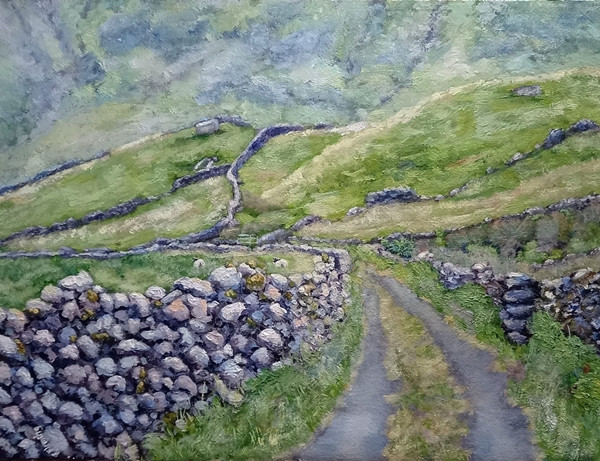
Some roads are remembered because they led somewhere important. Others mattered simply because they were used every day.
A lane to a house. A road to school. A way across fields. The turn taken on the way to town. These routes become ordinary very quickly. People stop noticing them because they know them so well.
Later, after someone leaves, they can become the part that stays clearest.
It is easy to think of emigration in terms of departure points: a station, a port, an airport, a final goodbye. But leaving also happens along smaller roads. The road from the house. The road past a neighbour’s gate. The road through the place where ordinary life had been happening until then.
Those roads remain after the person has gone.
Some are widened or resurfaced. Some narrow under grass. Walls are rebuilt. Houses change owners. New buildings appear. A route that once belonged to one family’s daily life becomes part of someone else’s.
But its basic shape may still survive.
That is what makes old roads so particular. They are practical things, but they are also shaped by repetition. The same feet, bicycles, carts, cars and animals passed along them over years. Journeys to work, school, church, shops, neighbours and fields. Nothing dramatic needed to happen for the road to become part of a life.
When people leave, that familiarity does not travel intact.
What remains may be fragments: the hill before the turn, the wall beside the road, the gate that was always difficult to open, the house just visible from a bend. A person may carry those details for years. Their children may know them only through stories.
The road itself continues without them.
That can make it strangely powerful.
A road does not preserve a life. But it can show where people passed, what connected one place to another, and how a house or farm sat within the land around it.
Painting can bring that back into view.
A road that might be overlooked in life can become central on the canvas. Its direction matters. So do the walls beside it, the rise of the ground, the point where it disappears.
That disappearance matters too.
A road leaving the frame continues somewhere beyond the painting, just as the lives once tied to it continued elsewhere.
For someone who left, it may carry the pull of return. For someone born later, it may offer something simpler: a way to picture the ordinary setting of a family story.
Not the dramatic parts. The everyday ones.
Where did they walk? What did they pass? What lay beyond the bend?
There may be no exact answers. But the surviving details of a place can still make an old story feel more tangible.
A wall shows where a boundary stood. A road shows how a house was reached. A gate shows where one piece of land met another.
Small things, but specific ones.
That specificity matters in painting too. A road is not only a symbol of departure or return. It is a road first: a surface, a line through land, a route between places.
If more comes from it, it should come from looking closely enough.
From the bend in the road, the wall beside it, the place where it disappears.
And from knowing that people once passed that way.