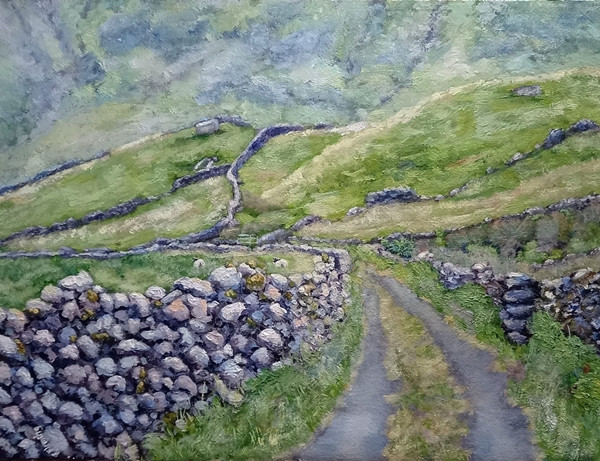
There are places we know because we have walked them often. We know where the road narrows, where the ground rises, where the wind catches, where the wall gives way to a gate.
And then there are places we know differently.
A town mentioned at the kitchen table. A county written on the back of an old photograph. A house remembered by someone who left it decades ago. A family name tied to a place no one in the next generation has actually seen.
That kind of knowledge is less certain, but not necessarily weaker.
For many people, Ireland is known partly through direct memory and partly through what has been handed down. A parent or grandparent may have remembered a farm, a road, a village, a particular view from a window. Over time, some details disappear. Others become more important because they are repeated. A place can be reduced to a handful of images and still matter.
Paintings can sit somewhere in that gap.
They do not prove anything about a family history. They are not documents. But they can bring a viewer close to the physical things that make a place recognisable: stone, weather, roads, field edges, the shape of a building against the land.
Sometimes that is enough.
A road between two walls may resemble no exact road the viewer has known, yet still feel familiar. A weathered building may recall a story about a house long gone. A garden, a gate or a line of trees may suggest a kind of home known only through other people’s words.
This is not quite nostalgia. Nostalgia usually belongs to something personally remembered. This is different: a sense that a place matters before it has become part of your own memory.
It may begin with family.
Someone left. Someone stayed. A name, photograph or story crossed the years. Later, another person may find themselves looking at the same county on a map, visiting for the first time, or standing in front of a painting and finding the subject strangely familiar.
The landscape itself does not explain that feeling. It simply remains.
Roads continue to be used. Walls are repaired or fall down. Houses change hands. Fields are divided, joined, worked differently. Trees grow where there were none. Buildings disappear. Others remain long enough to become landmarks for people who never knew who built them.
This is why ordinary places matter.
A dramatic view can be beautiful without being personal. But a narrow road, a low wall or an old outbuilding can carry the shape of daily life. These are the things people used without thinking much about them at the time. Later, they may become the things most closely associated with home.
Painting slows them down.
A wall becomes more than background. A bend in the road becomes the centre of the picture. A weathered surface is looked at long enough for its age and use to become visible.
The result cannot reconstruct someone else’s memory. But it can give that memory, or an inherited connection to it, something physical to meet.
That may be enough.
Not because the painting tells the viewer what a place means, but because it gives them something specific enough to recognise for themselves.